
The Model Maker
Jayesh Srinivasa Ellayah
Theories of Architecture and Urbanism
(ARC61303)
The subject offers a thematic inquiry into architectural and urban theory in the broader context of philosophical schools of thought and cultural and social conditions, which include modernism, postmodernism, phenomenology, semiotics, post-structuralism, deconstruction and critical regionalism. These themes will guide the organization of weekly lecture and discussions, which will proceed from the establishment of a basic theoretical apparatus to the examination of specific cases. These will supply us with tools for the analysis of specific architectural situations. Students will develop a written synopsis of a designated reading, and an in-depth and analytical research paper on the designated topic.
MODULE LEARNING OUTCOMES
1. Describe the theoretical issues related to design through study of architecture and urbanism and its related studies.
2. Identify the different architectural theories which inform the development of architecture and urban forms.
3. Analyze and critique the relationship between architecture and its social, cultural, and intellectual context.
4. Analyze architecture and urban forms in relation to relevant architectural theories.
5. Produce, orally and in writing, a critical interpretation of architecture and urbanism in relation to relevant theories within the contemporary discourse of architecture.
Synopsis
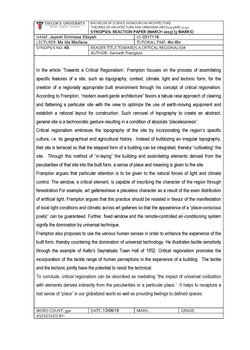
A reaction or response paper requires the writer to analyze a text, then develop commentary related to it. It requires thoughtful reading, research and writing. It should identify the key points highlighted in the text and then focus on your personal perspective on issues raised through the text. In addition to your personal perspective, you should identify experiences or insights that have shaped your perspective.
REACTION PAPERS:
1. The Death and Life of Great American Cities, Jane Jacobs
2. Semiotics and Architecture: Ideological Consumption or Theoretical Works, Diana Agrest and Mario Gandelsonas
3. The Geometry of Feeling: A Look at Phenomenology of Architecture, Juhani Pallasmaa
4. Towards a Critical Regionalism: Six Points for an Architecture of Resistance, No. 5 & 6, Kenneth Frampton
Project Part A: Identifying 5 Elements
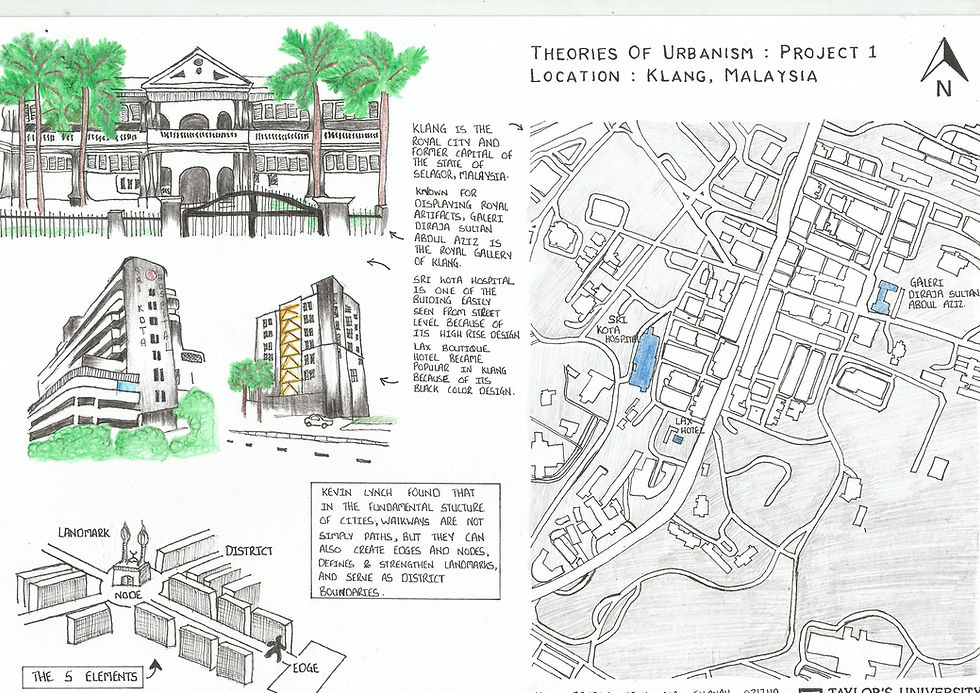
Lynch's most famous work, The Image of the City(1960), is the result of a five-year study on how observers take in information of the city. Using three disparate American cities as examples (Boston, Jersey City and Los Angeles), Lynch reported that users understood their surroundings in consistent and predictable ways, forming mental maps with five elements:
-
paths, the streets, sidewalks, trails, and other channels in which people travel;
-
edges, perceived boundaries such as walls, buildings, and shorelines;
-
districts, relatively large sections of the city distinguished by some identity or character;
-
nodes, focal points, intersections or loci;
-
landmarks, readily identifiable objects which serve as external reference points
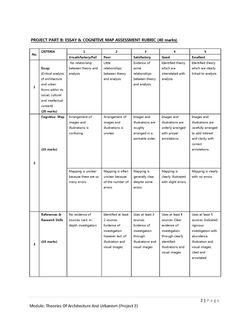
Project Part B: An Illustrated Essay with a Cognitive Mapping of Selected Urban Spaces
Part B of the project requires students to create cognitive mapping of selected significant urban spaces in the city of Klang to understand one’s perception and spatial behaviour in cities today. Using the cognitive map students are required to present a critical understanding of emerging contemporary urbanism in Klang city spaces (in relations to Kevin Lynch notions of imageability and how it influences people’s perception of the city. Mapping should contain: human facets (memory, identity etc.), spatial and temporal dynamics (traffic, people’s paths, barriers, etc.), architecture (stairs, benches, trees, etc.), microstructures (texture, material).
The illustrated essay can be read below
LEARNING OUTCOMES (PART A & B):
1. Analyze architecture and urban forms in relation to relevant architectural theories.
2. Analyze and critique the relationship between architecture and its social, cultural, and intellectual context.
3. Produce, orally and in writing, a critical interpretation of architecture and urbanism in relation to relevant theories within the contemporary discourse of architecture.
 |  |  |
|---|---|---|
 |


 |  |  |  |  |  |  |
|---|---|---|---|---|---|---|
 |  |  |  |  |  |  |
 |  |  |  |  |